

 Türkçe
Standard Containers (Dryvan): Standard containers are containers used for general purposes. All kinds of dry cargo are transported with these containers. Although the dimensions are generally 20′ and 40′, 45′ and recently 54′ long containers have started to be used.
High Cube Containers: Although this type of containers are structurally similar to standard containers, they are a type of container that allows loading more internal volume with a height of 2896 mm than box containers with a height of 2591 mm. It is generally produced as 40′. It is used in the transportation of all kinds of dry cargo, light and bulky cargo and oversized cargo with a height of up to 2.7m.

* All container dimensions in the table above are outlined. Installers must consider tolerance margins.
Open Top Containers: The difference between open top containers and standard containers is that the ceiling is completely open. After the inside is filled, it is covered with a tarpaulin. Generally, its dimensions are 20′ and 40′ in length. Since it allows loading the load from above, its natural areas of use are oversize loads that cannot fit through the container door and loads that need to be handled with crane-like equipment.

* All container dimensions in the table above are outlined. Installers must consider tolerance margins.
Flatrack Containers: Flatrack containers are transportation vehicles consisting of a base platform and two end walls. When necessary, the end walls can be fixed vertically or closed and turned into a carrying platform by laying on the bottom. It is generally produced in 20′ and 40′ sizes. Areas of use are heavy tonnage loads, large or high overflow loads. It is also used to transport and secure high volume break bulk cargo by creating a platform from two or more flatrack containers.
Platforms: Platforms are structurally only in the form of a base platform. It has no end or side walls. It is suitable for carrying heavy tonnage loads in small areas. Sizes are generally produced as 20′ and 40′. Areas of use are oversize loads and heavy tonnage loads.
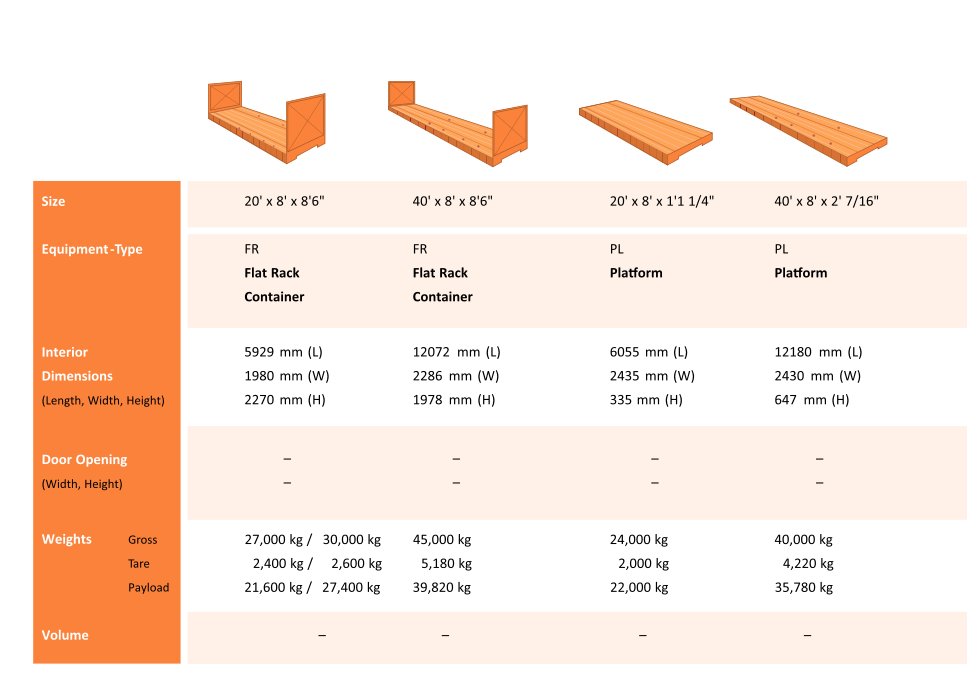
* All container dimensions in the table above are outlined. Installers must consider tolerance margins.
Refrigerated (Reefer) Containers: Reefer containers are specially insulated containers with a cooling unit inside. It is generally produced in 20′ and 40′ sizes. High cube containers are used to transport light and bulky loads (flowers, fruits, etc.). These are food products that are transported at constant temperatures whose natural use is below or above 0 ºC.
Tank containers: Tank containers are used to transport liquid or gaseous cargo. A cylindrical tank is placed inside a steel rectangular construction structure.
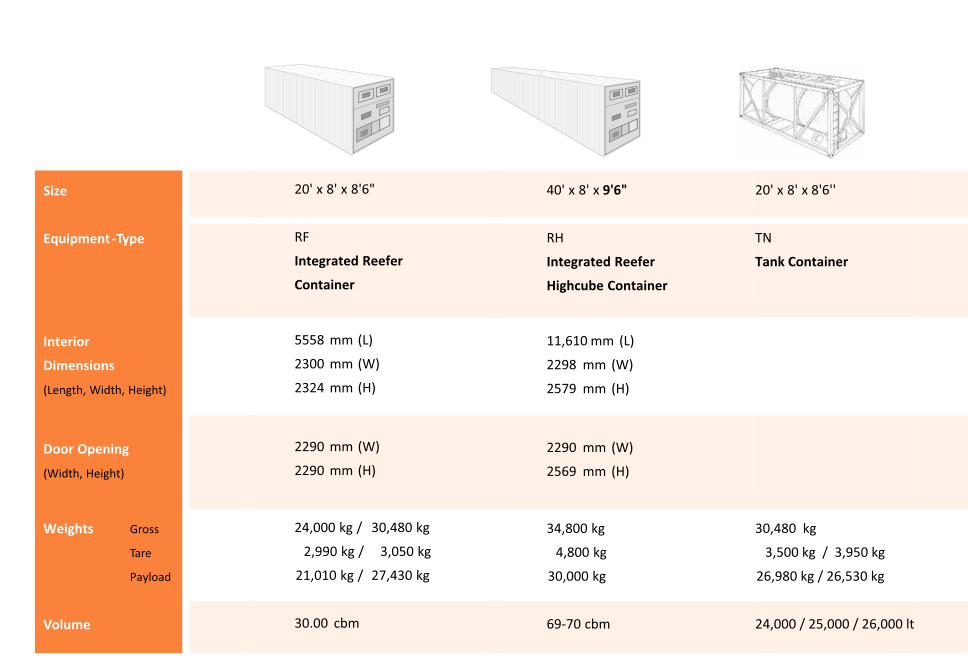
* All container dimensions in the table above are outlined. Installers must consider tolerance margins.